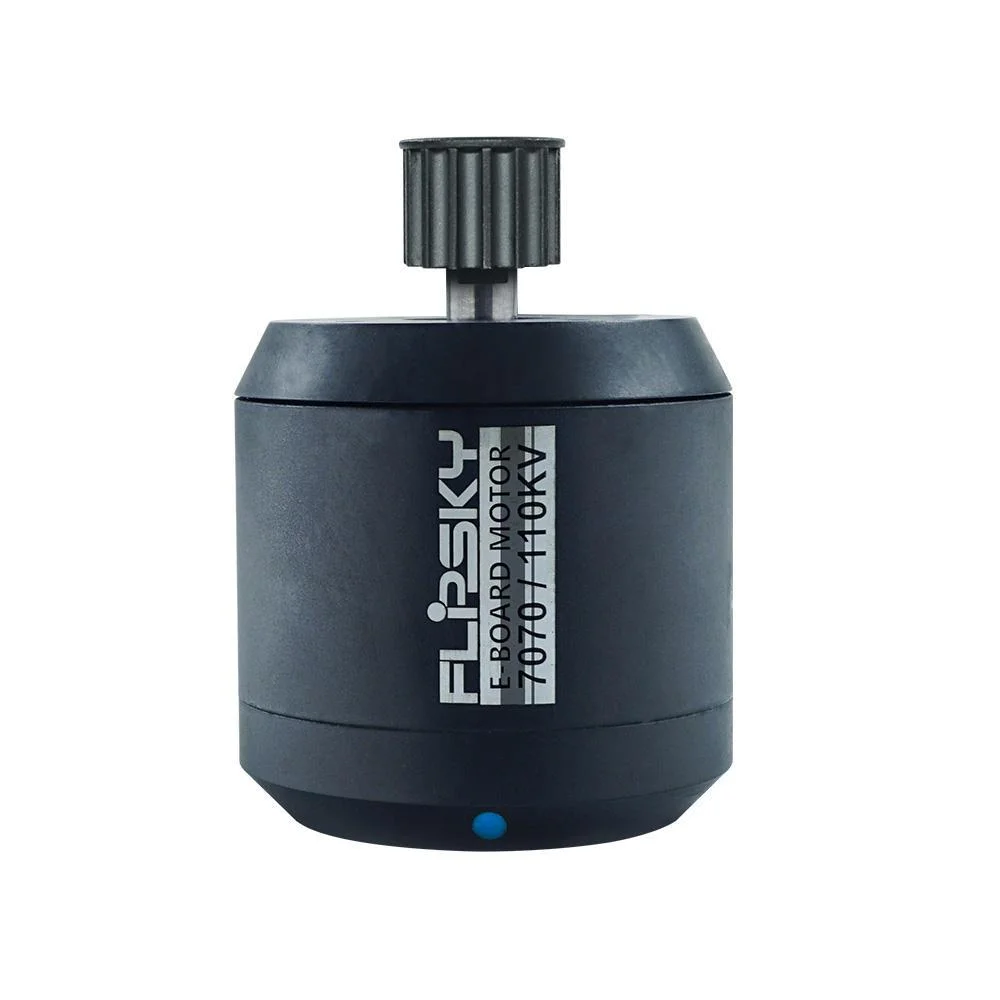
Flipsky 7070 Sensored Outrunner Brushless DC Motor: Applications in UGVs, Electric Skateboards & E-Bikes
The demand for compact, high-performance electric mobility systems is rapidly increasing across robotics, personal transportation, and electric vehicles. At the heart of many of these systems is the BLDC (Brushless DC) motor, which offers high efficiency, excellent torque-to-weight ratio, and precise speed control.
The Flipsky 7070 Sensored Outrunner Brushless DC Motor is a powerful option for applications where strong acceleration, compact packaging, and responsive motor control are important. With a sensored configuration, the motor can provide improved rotor-position feedback, making it particularly useful for low-speed operation and applications requiring controlled starts.
This makes the 7070 motor suitable for projects such as UGVs, electric skateboards, e-bikes, robotic platforms, and other compact electric drive systems.
What Is the Flipsky 7070 Sensored Outrunner Motor?
The Flipsky 7070 is an outrunner-style BLDC motor. Unlike an inrunner motor, where the rotor rotates inside the stator, an outrunner motor has the rotating outer section surrounding the stationary stator.
This construction provides a useful combination of torque, compact size, and power density, making outrunner motors popular in electric skateboards, robotics, drones, and other electric-drive applications.
The sensored design incorporates rotor-position sensors, commonly Hall sensors. These sensors allow the motor controller to determine the approximate rotor position, which can improve:
- Low-speed control
- Starting performance
- Throttle response
- Direction control
- Smooth acceleration
- Controlled operation under varying loads
For robotics and mobility applications, these characteristics can be particularly valuable because the motor may need to start from zero speed while carrying a significant load.
Why Use a Sensored BLDC Motor?
A sensorless BLDC system estimates rotor position using electrical characteristics generated by the motor. This can work very well at moderate and high speeds, but very-low-speed operation and startup can be more challenging.
A sensored motor provides the controller with direct rotor-position information.
Advantages of a Sensored BLDC Motor
- Better Low-Speed Control: Useful when a vehicle or UGV needs to move slowly and precisely.
- Improved Startup: The controller can determine rotor position before applying the appropriate commutation sequence.
- Better Throttle Response: Position feedback can contribute to predictable motor response.
- Useful for Robotics: UGVs often operate at low speeds and require controlled acceleration, making sensored motors attractive for these applications.
Using the Flipsky 7070 in a UGV
One of the interesting applications for a 7070 motor is a small or medium electric UGV (Unmanned Ground Vehicle).
A UGV typically consists of:
Battery → Motor Controller → BLDC Motor → Reduction/Transmission → Wheel
The motor converts electrical energy from the battery into mechanical torque that drives the wheels.
How to Integrate It Into a UGV
A typical UGV drivetrain can use one motor per driven wheel or one motor per side, depending on the mechanical architecture.
Differential Drive UGV
Two motors can be used:
- Left-side motor
- Right-side motor
The controller independently regulates both motors.
This allows the UGV to:
- Move forward
- Move backward
- Turn left
- Turn right
- Rotate in place
This configuration is especially useful for robotics platforms.
Four-Wheel Drive UGV
A larger platform can use multiple motors.
Possible configurations include:
- 2 motors + mechanical differential
- 4 motors + independent electronic control
The correct configuration depends on vehicle weight, wheel diameter, terrain, desired speed, and required climbing ability.
Gear Reduction Is Important for UGVs
One of the most important considerations when using a high-speed BLDC motor in a UGV is gear reduction.
A motor may rotate much faster than the vehicle's wheels should rotate.
Instead of connecting the motor directly to the wheel, a reduction mechanism can be used:
Motor → Gear/Chain/Belt Reduction → Wheel
For example, with a theoretical 4:1 reduction:
- Motor speed = 4000 RPM
- Wheel speed ≈ 1000 RPM
The tradeoff is that the wheel receives substantially more torque while rotating more slowly.
This is particularly useful for:
- Heavy UGVs
- Off-road robots
- Climbing applications
- Industrial mobile robots
- Low-speed autonomous platforms
Flipsky 7070 for Electric Skateboards
The electric skateboard is one of the most natural applications for an outrunner BLDC motor.
A typical electric skateboard drivetrain consists of:
Battery Pack → ESC/VESC → Motor → Belt Drive → Wheel
Belt-Drive Configuration
The 7070 motor can be integrated into a skateboard using a pulley and belt system.
The motor pulley drives a larger wheel pulley.
For example:
Small motor pulley + larger wheel pulley = gear reduction
This allows the motor to operate at a higher RPM while delivering useful torque at the wheel.
Why Use Belt Drive?
- Easy gearing changes
- Mechanical isolation
- Compact drivetrain
- Replaceable belts
- Good torque multiplication
- Flexible motor positioning
Single-Motor vs Dual-Motor Skateboard
The motor can be considered for both single- and dual-motor skateboard configurations, provided the motor, controller, and battery combination is appropriately matched.
Single Motor
One motor drives one truck or wheel assembly.
Advantages:
- Lower system cost
- Lower battery consumption
- Simpler electronics
- Easier installation
Dual Motor
One motor is used on each driven side.
Advantages:
- Higher available traction
- Better acceleration potential
- Improved hill-climbing capability
- More balanced power delivery
However, using two motors also increases electrical power requirements, controller requirements, thermal demands, and battery requirements.
Using the Flipsky 7070 Motor in an E-Bike
The same motor concept can also be explored for electric bicycles, especially custom-built or performance-oriented projects.
Instead of directly attaching the motor to the wheel, a custom e-bike can use a mid-drive-style mechanical arrangement.
A simplified drivetrain looks like:
Battery → Motor Controller → 7070 Motor → Reduction → Chain/Belt → Rear Wheel
The reduction system converts the motor's higher rotational speed into increased wheel torque.
This can be useful for:
- Custom e-bike builds
- Experimental electric vehicles
- Performance prototypes
- Robotics-inspired mobility platforms
- Engineering projects
For a road-going e-bike, the motor's power, speed, controller, battery, and vehicle configuration should be selected to comply with applicable local regulations.
Choosing the Right Motor Controller
The motor is only one part of the electrical system.
A suitable BLDC motor controller/ESC is required to regulate:
- Motor current
- Battery current
- Acceleration
- Regenerative braking, if supported
- Direction
- Motor temperature protection
- Over-current protection
For applications requiring advanced control, a VESC-compatible controller can be particularly useful because it provides configurable motor-control parameters and telemetry.
The controller must be selected according to the motor's electrical characteristics rather than simply choosing a controller based on its advertised maximum current.
Battery Selection
The battery must also be matched to the complete powertrain.
A typical system consists of:
Battery → Fuse/Protection → ESC → Motor
Voltage
The battery voltage must be compatible with the motor controller and motor operating limits.
Current Capability
The battery must be capable of supplying the required current without excessive voltage sag or overheating.
Capacity
Battery capacity determines the available energy and therefore strongly influences operating range.
For example:
Battery Energy ≈ Voltage × Amp-hours
A higher-capacity battery can provide greater theoretical energy, but it also increases weight and physical size.
Thermal Management
High-performance BLDC motors can generate considerable heat during demanding operation.
Thermal management becomes especially important in:
- Heavy UGVs
- Long-duration operation
- Steep climbs
- High acceleration
- High-current applications
- Off-road environments
Motor temperature should be monitored where practical, and the motor should not be operated continuously beyond its thermal capabilities.
The same principle applies to the ESC and battery.
A powerful motor paired with an undersized controller or battery can become a system-level limitation.
UGV vs Skateboard vs E-Bike
- UGV: Gear, chain, or belt reduction — torque and low-speed control
- Electric Skateboard: Belt drive — acceleration and compact packaging
- E-Bike: Chain or belt reduction — wheel torque and efficiency
- Robotic Platform: Gear reduction — precise low-speed movement
- Custom EV: Reduction drivetrain — power and thermal management
The important point is that the motor alone does not determine vehicle performance.
Performance depends on the complete system:
Motor + Controller + Battery + Reduction + Wheel + Vehicle Weight
Example UGV Powertrain
A conceptual UGV system could look like:
Battery Pack → Fuse/Protection → VESC/BLDC Controller → Flipsky 7070 Sensored Motor → Belt/Chain/Gear Reduction → Drive Wheel
For a differential-drive platform:
- Left Motor → Left Wheel
- Right Motor → Right Wheel
The vehicle controller can then command both motors independently.
This enables autonomous navigation, remote control, obstacle avoidance, and precise directional movement when combined with the appropriate sensors and control software.
Example Electric Skateboard Powertrain
A skateboard configuration can use:
Battery Pack → BMS/Protection → VESC/ESC → Flipsky 7070 Motor → Motor Pulley → Belt → Wheel Pulley → Drive Wheel
A dual-motor configuration can add another motor and appropriate controller channel as required.
Example E-Bike Powertrain
For a custom electric bike:
Battery → Motor Controller → Flipsky 7070 → Reduction Drive → Chain/Belt → Rear Wheel
A reduction stage is particularly important because it allows the motor's operating speed to be converted into useful wheel torque.
Key Factors to Consider Before Building
Before integrating a Flipsky 7070 motor into a vehicle, evaluate:
- Vehicle Weight: A heavier vehicle requires more wheel torque.
- Wheel Diameter: Larger wheels generally require more motor torque for the same acceleration and gradient.
- Target Speed: Determine the required wheel RPM before selecting the reduction ratio.
- Gear Ratio: Select the ratio to balance acceleration, climbing ability, and top speed.
- Controller: Choose a controller capable of handling the required motor and battery current.
- Battery: Ensure sufficient voltage, current capability, capacity, and appropriate protection.
- Cooling: Check motor, ESC, and battery temperatures during demanding operation.
- Mechanical Mounting: The motor mount must withstand vibration, belt or chain tension, and drivetrain loads.
Why the Flipsky 7070 Is Interesting for Robotics & Mobility
The combination of an outrunner BLDC architecture and sensored feedback makes this type of motor attractive for experimental electric-drive applications.
It can be considered for projects where designers need:
- High power density
- Compact motor packaging
- Fast response
- Low-speed controllability
- Programmable electronic control
- Custom mechanical gearing
- Integration with robotics systems
Rather than treating the motor as a standalone component, engineers should design the entire drivetrain around the required vehicle performance.
Conclusion
The Flipsky 7070 Sensored Outrunner Brushless DC Motor can be a versatile building block for custom electric mobility and robotics projects.
In a UGV, it can be combined with a reduction drivetrain to provide controlled wheel torque for autonomous or remote-controlled platforms.
In an electric skateboard, a belt-drive arrangement can convert the motor's rotational speed into useful wheel torque while maintaining a compact drivetrain.
In a custom e-bike, a suitable reduction system can integrate the motor into the bicycle's mechanical drivetrain.
The most important consideration is proper system matching. Motor, ESC, battery, gearing, wheels, vehicle weight, and thermal management must all be designed together to achieve reliable performance.
For builders and engineers developing UGVs, AGVs, electric skateboards, e-bikes, and custom robotic vehicles, the 7070 platform offers an interesting foundation for developing compact and high-performance electric drivetrains.